futures data API comparison: polygon vs databento vs edgeful (2026 guide)

choosing a futures data API in 2026 is harder than it should be. polygon vs databento is the comparison most builders run first, and then they hit edgeful and realize it's not the same kind of API at all.
this guide does the apples-to-apples comparison where it makes sense (polygon vs databento for raw market data), and then explains why the third option, the edgeful futures data API, sits in a different category entirely. all pricing here is verified against each provider's public site as of may 2026.
table of contents
- quick comparison: polygon vs databento vs edgeful at a glance
- the category difference (why this comparison isn't apples to apples)
- polygon.io futures data API (now massive.com)
- databento futures data API
- edgeful futures data API
- which futures data API should you use? (decision by use case)
- pricing summary: total cost of getting actual edge data
- key takeaways
quick comparison: polygon vs databento vs edgeful at a glance
this table is the whole article in 30 seconds. the rest of the piece explains why each row matters and which futures data API fits which type of builder.
the category difference (why this comparison isn't apples to apples)
most futures data API comparisons treat every provider the same way: who has more tickers, who has cheaper real-time, who has deeper depth. but polygon, databento, and edgeful aren't competing for the same job.
polygon and databento sit at the raw market data layer. you get ticks, quotes, OHLCV bars, sometimes order book depth. everything else (your indicators, your probability calcs, your conditional statistics) you write yourself.
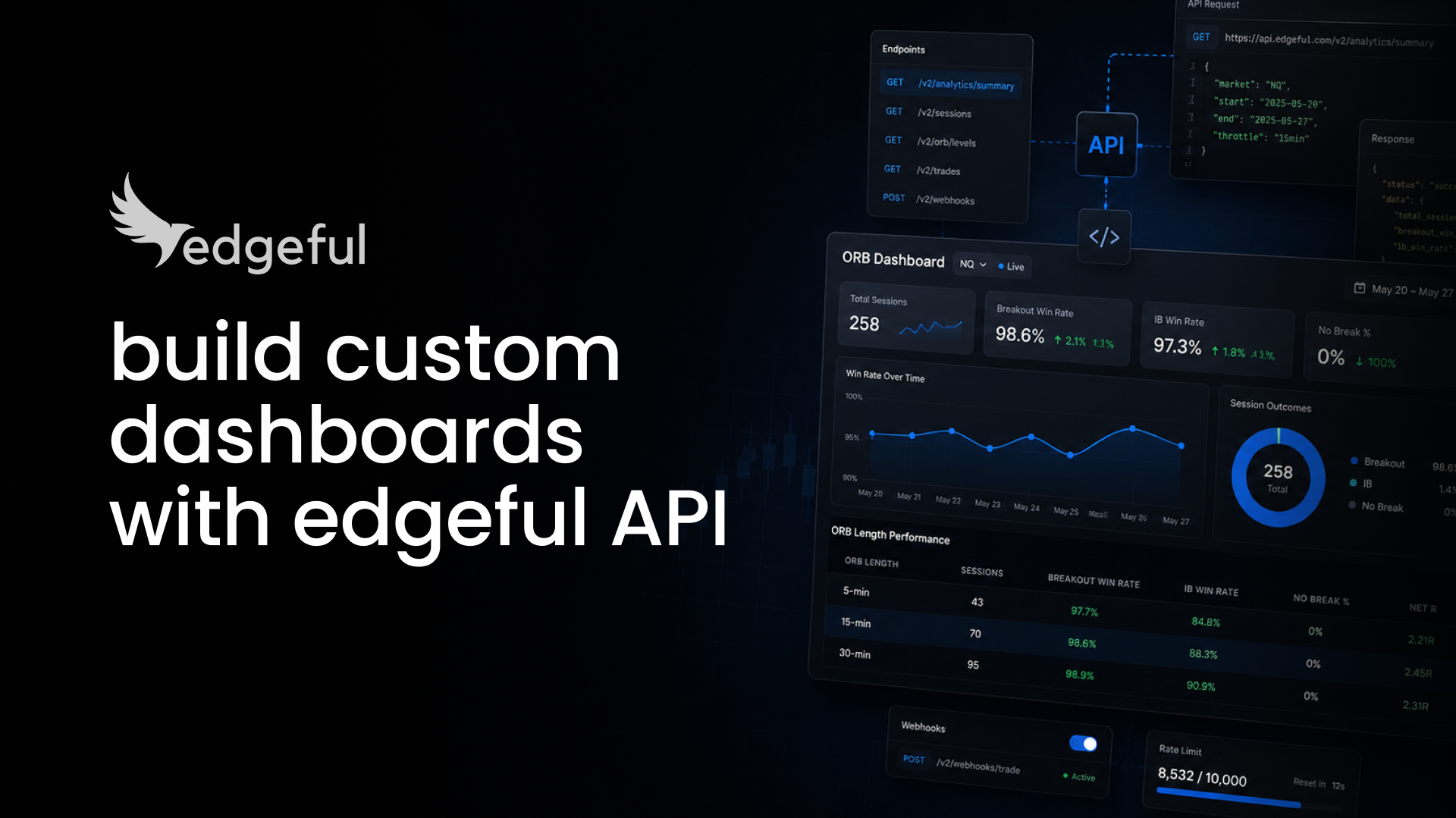
edgeful sits at the computed statistics layer, one floor up. the API doesn't return ticks. it returns probability reports built on top of those ticks: gap fill rate by ticker, initial balance break percentages by weekday, opening range breakout win rates by session, opening candle continuation statistics. 150 reports total, all computed, all queryable from one endpoint.
the analogy that lands for most builders: polygon and databento are the gas station. edgeful is the rental car with a full tank. you can buy both. you can also buy only one, depending on the trip you're taking.
polygon.io futures data API (now massive.com)
quick note before we get into specs: polygon.io rebranded to massive.com in 2026. the API endpoints, docs, and pricing pages now live at massive.com, but the product is the same. most traders still call it polygon, so we will too for the rest of this guide.
polygon's futures data API covers the full CME group (CME, CBOT, NYMEX, COMEX), plus stocks, options, indices, forex, and crypto in separate subscriptions. each asset class is its own bill. you pay for stocks, then again for options, then again for futures.
pricing for stocks (futures is similar):
- Basic: $0/mo, end-of-day data
- Starter: $29/mo, 15-minute delayed
- Developer: $79/mo, 15-minute delayed
- Advanced: $199/mo, real-time
- Business: $2,000/mo, real-time with commercial license
what you get on any tier is the same shape: raw market data. OHLCV aggregates, ticks, quotes, snapshots. polygon does that part well, the docs are clean, and the websocket connections are reliable.
what you don't get is any of the statistics you actually trade on. polygon will tell you that NQ printed a low of 21,440 at 09:47 yesterday. it won't tell you what percentage of NQ sessions in the last 6 months have made their session low within the first 30 minutes of the NY open. that calculation, you write yourself. for a lot of builders, that's the right tradeoff. for others, it's a 200-hour project they didn't sign up for.
best fit: builders who want full control over the statistical layer and have time to write it. if you've worked on this before, you know how much of that time goes into edge cases (session boundaries, weekend gaps, holiday halves). there's a reason we wrote a whole post on the right and wrong way to backtest once you have the raw data in hand.
databento futures data API
databento sits in a different niche than polygon. it's the institutional-grade futures data API, with a heavy focus on tick-level fidelity, deep order book data (L2 and L3 / MBO), and venues that quants care about: CME, CBOT, NYMEX, COMEX, plus equities and options on futures via OPRA.
pricing is a hybrid: pay-as-you-go ($/GB on historical) or one of three subscription tiers.
- pay-as-you-go: $/GB billed on uncompressed binary encoding, $125 in free credits for new users
- Standard: $199/mo, monthly billing, historical-only (no live data), external distribution not included
- Plus: $1,399/mo, annual contract required, live data + external distribution
- Unlimited: $3,500/mo, annual contract required, complete history at full depth
the headline number that catches most futures traders off guard: real-time data starts at $1,399/mo on an annual contract. that's a 7x jump from the historical-only tier. it's also $1,200/mo more than polygon's $199 real-time entry, but you're getting institutional-grade depth and microsecond timestamps in return.
what you don't get, same as polygon: any computed statistics. databento's value is in the fidelity of the raw data, not in answering trading questions. you still write every probability calculation, every conditional join, every rolling stat. for the right user, that's the whole point.
best fit: quants and microstructure researchers who need tick-level fidelity and full order book depth, with the budget for institutional pricing.
edgeful futures data API
the edgeful futures data API is the third option, and it doesn't compete with polygon or databento on raw market data. it competes on a different axis entirely: how fast you can go from "i want to know X" to "here's the answer."
every report on the edgeful platform (gap fills, initial balance, opening range breakouts, opening candle continuation, inside bars, power hour, session ranges, and 143 more) returns as structured JSON from one API. you don't pull ticks, aggregate them into bars, filter by session, group by weekday, then compute the conditional rate. you make one request and the answer comes back.
pricing:
- essential: $49/mo, includes limited API access (4 tickers: RTY, AAPL, ETH/USDT, GBP/CAD; 3 reports; 6 months of history; EOD only). good for testing the API at a low entry price.
- pro: $99/mo, the API tier. full edgeful API access, all tickers, all reports, live what's-in-play and screener feeds (not raw tick data), 1 year of history on the API
- all-access: $299/mo, the algo tier. everything in pro plus the algo suite, 8 years of history, row-level detail
best fit: traders or AI builders who need a trustable structured data source for claude/cursor/chatgpt, and anyone building dashboards, alerts, or journal-cross-reference tools without writing their own statistical engine.
if you want to test it yourself, the edgeful API quickstart walks through getting a key and pulling your first stat in under 5 minutes.
which futures data API should you use? (decision by use case)
the comparison becomes simple once you know what you’re building.
- you're building a backtest engine on tick data, or you need raw OHLCV across multiple asset classes. polygon is the right futures data API. cheap real-time, broad coverage, reliable infrastructure. you'll write your own statistics on top.
- you need L2/L3 order book depth, microsecond timestamps, or you're doing microstructure research. databento is the right futures data API. pay for the institutional pricing because that's the data you actually need.
- you want pre-computed probability statistics on top of futures data, queryable from one endpoint, that your AI agent can consume directly. edgeful is the right futures data API. don't pay for ticks you'd never look at.
pricing summary: total cost of getting actual edge data
if you collapse the comparison to what the cheapest real-time tier costs, the numbers tell a clear story.
- polygon: $199/mo for one asset class real-time (stocks or futures or options, each a separate subscription)
- databento: $1,399/mo annual for futures real-time + external distribution
- edgeful: $99/mo on pro for the full library of 150 reports, every ticker, with live what's-in-play and screener feeds (not raw tick data)
if the question you're trying to answer is what's the probability of X happening on Y ticker, paying $1,399/mo for tick data to compute it yourself is the wrong tool. paying $99/mo for the already calculated answer, and then feeding that into your AI workflow is the right way to go.
key takeaways
- the polygon vs databento vs edgeful comparison isn't apples to apples. polygon and databento sell raw market data (ticks, OHLCV, depth). the edgeful API gives you direct access to over 150+ probability reports, and allows you to feed that data directly into your AI agents.
- edgeful's futures data API is on every paid tier. essential at $49/mo gets limited API access (4 tickers, 3 reports, 6mo history). pro at $99/mo opens up the full library: every ticker, all 150 reports, live what's-in-play and screener feeds (not raw tick data), 1 year of history. all-access at $299/mo adds 8 years of history, row-level data, and the algo suite. best for traders and AI builders who want pre-computed answers.
risk disclaimer
historical data does not guarantee future returns. the lift, win rate, and probability numbers referenced in this guide are illustrative of what each futures data API can compute, not trade signals on their own. market conditions change, statistical edges decay, and live trading still requires customization, risk management, and effort beyond pulling stats. any results referenced (including the 1.23x lift example) are based on a specific window of NQ data and should be re-verified against current windows before use.
FAQs