day trading morning routine: 3 checks before 10:30 AM ET (data-backed)
most traders sit down 5 minutes before the open, pull up a chart, and start scanning for setups without any real plan. that's not a day trading morning routine. that's hoping something looks good enough to click.
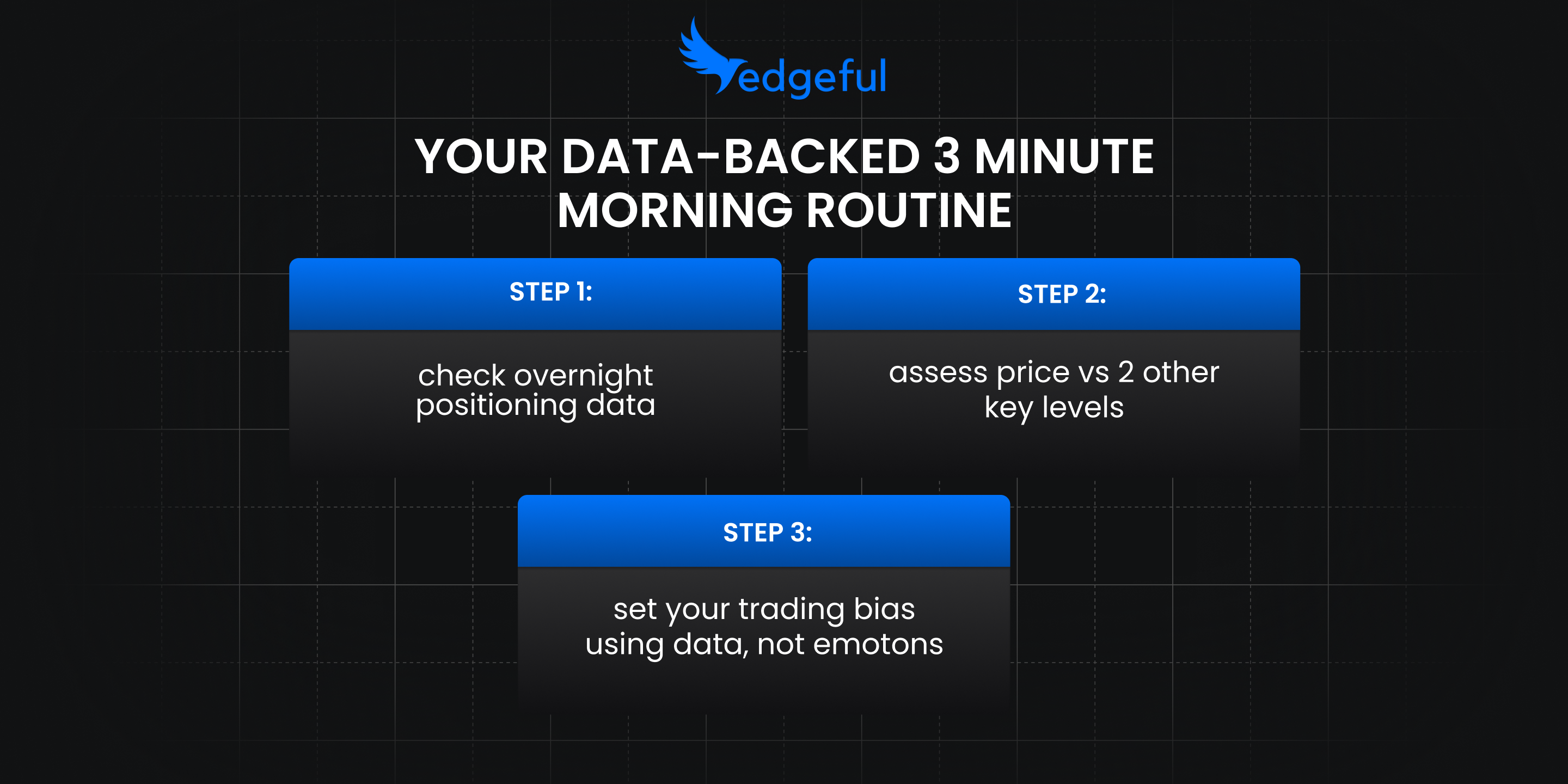
the fix isn't a smarter indicator or a more complex setup. it's a simple, repeatable day trading routine that takes about 3 minutes. 3 reports, 3 checks, and by 10:30 AM ET you know which setups are live, which direction the data leans, and where your targets and stops are.
I want to walk you through the exact day trading morning routine I run every session.
table of contents
- the 3-check day trading morning routine at a glance
- why a structured day trading morning routine outperforms gut feel
- check 1: gap status (before the open)
- check 2: inside bar status (before the open)
- check 3: initial balance read (at 10:30 AM ET)
- mid-session: the screener bias bar
- the "nothing in play" morning
- common mistakes that kill a day trading routine
- how to build your own day trading morning routine
- key takeaways
the 3-check day trading morning routine at a glance
before we go deep, here's the full pre-market checklist in one table. each check uses one edgeful report, takes about a minute, and gives you a day trading setup with defined targets and stops.
- check 1: gap status
- report: gap fill
- when: before 9:30 AM ET
- tells you: is there a fadeable gap with a high fill rate?
- check 2: inside bar status
- report: inside bars
- when: before 9:30 AM ET
- tells you: did today open inside yesterday's range? if yes, yesterday's high and low become targets
- check 3: initial balance read
- report: initial balance (IB)
- when: 10:30 AM ET
- tells you: which side of the first hour's range is more likely to break, and where to enter on a pullback
3 reports. 3 checks. one full session plan by 10:30 AM ET. that's the entire day trading morning routine.
why a structured day trading morning routine outperforms gut feel
most traders skip the morning prep because they think the work happens after the open. the chart is moving, candles are forming, and that's when "real" trading happens.
but the traders I've worked with who are consistently profitable do almost the opposite. the work happens before the open. they sit down with a plan, a bias built from data, and defined levels they care about. when the bell rings, they're not reacting. they're executing.
a structured day trading routine does three things for you.
it removes the "what do I trade today" question. the reports tell you. if the gap is fadeable, that's a day trading setup. if it's an inside bar day, that's another setup. if neither shows up, you've got the IB at 10:30 to check.
it gives you stops and targets from real data instead of from the next round number that catches your eye. that means your risk is defined before you're in the trade, not after price moves against you.
and it builds confidence. when you know your check 1 setup has hit 64% over the last 6 months on ES, you don't second-guess the entry. you don't move your stop. you let the data do the work it's supposed to do.
results still require time and effort. the routine itself takes 3 minutes, but learning to trust the data, finding the tickers and timeframes that fit your style, and sticking to the process across losing sessions takes work. there's no shortcut.
check 1: gap status (before the open)
the first step in the day trading morning routine is the gap. open the gap fill report and check today's gap.
is it a gap up or a gap down? how big is it?
the report tells you how often gaps of that size fill during the NY session. if the fill rate is high, that's your first potential setup of the day. from there, the by spike subreport shows you the average adverse move before the fill happens. that's your stop. the fill level, which is yesterday's close (PSC), is your target.
so before the bell even rings, you've got a day trading setup with a defined stop and a defined target, all from the data.
according to edgeful data, on ES over the last 6 months during the NY session, gap ups have filled 61% of the time and gap downs have filled 64%. on NQ, it's 53% for gap ups and 56% for gap downs. NQ's gap fill setup isn't the cleanest play out there, but the data is dynamic and changes every session. that's why this check runs every morning, not once a quarter.
if the gap is small and the fill rate is high, you're looking at a tradeable setup. if it's a large gap with a low fill rate, you skip it and move on to check 2. that's the whole point of having a day trading morning routine. the data tells you when to trade and when to stand down.
this is also why the gap and go strategy works for some traders and not others. the difference isn't the strategy. it's whether they checked the actual fill rate for that ticker and gap size before they took the trade. plenty of traders run a gap and go strategy on instinct alone and wonder why their results are inconsistent. the gap fill check turns the gap and go strategy into a data-backed setup instead of a guess.
check 2: inside bar status (before the open)
next, check if today's open is within yesterday's range. below yesterday's high, above yesterday's low. if yes, that's an inside bar day.
I broke this down in detail in inside day in trading, but here's the quick version. on an inside bar day, yesterday's high and low become your targets. price tends to break out of the previous day's range and target one of those levels.
on ES over the last 6 months, price reaches one of those levels 87.84% of the time. on NQ, it's 87%. those are some of the highest hit rates across any setup in edgeful.
so now you've got a second day trading setup on the board. targets defined by the data, and you haven't even hit the opening bell yet. this is where a real day trading routine starts to pay for itself. you're stacking setups before the session starts, not chasing them after.
this also doubles as a useful intraday trading strategy on days where the gap check is a no-go. if there's no fadeable gap but it's an inside bar day, you've still got a setup with a defined target. the inside bar setup is one of the cleanest intraday trading strategy plays for traders who don't want to fight a low-fill-rate gap. and you've checked both setups in under 2 minutes.
check 3: initial balance read (at 10:30 AM ET)
this one you can't run at the open. it needs the first hour to form.
at 10:30 AM ET, the initial balance is set, which is the high and low of the first hour of the NY session. pull up the initial balance report.
the by rejection subreport analyzes which side of the IB formed first, and that tells you which side is more likely to break. on ES over the last 6 months, when the low formed first, price broke the IB high 78% of the time. when the high formed first, the IB low broke 75% of the time.
the by retracement subreport tells you where to enter on the pullback. the 25% retracement level is the sweet spot for most tickers.
the by levels subreport tells you how far the breakout extends. you'll have to check the exact extension data on ES and NQ yourself, but these three subreports together give you everything you need to build a data-backed entry, stop, and target plan for the IB breakout.
3 reports, 3 checks. by 10:30 AM ET, you've got a session plan with multiple data-backed setups, real stops, and real targets. that's the full day trading morning routine.
mid-session: the screener bias bar
here's the part nobody talks about. the session doesn't always play out the way the morning data suggested.
news drops. price reverses. the gap that was filling starts ripping into your stop. the inside bar setup that looked clean at the open suddenly looks shaky.
this is where the what's in play screener comes in. the screener is different from the what's in play dashboard. WIP shows you one ticker across multiple reports. the screener shows you multiple tickers across multiple reports at once, and it builds a real-time bias from the price action.
after 10:30 AM ET, once the IB and the other first-hour reports have finished forming, the screener gives you a read on where the broader market is leaning.
the daily bias bar at the top of the screener aggregates all the bullish and bearish reads across your selected tickers and reports into one visual.
- 65%+ green: the data is leaning bullish, lean long
- 65%+ red: the data is leaning bearish, lean short
- mixed, no clear majority: choppy, consider sitting out or reducing size
here's the key. that bias bar updates throughout the session. if you started the morning bullish because the bias bar was 70% green, but by 1 PM it's flipped to 60% red, the data is telling you the market environment has changed.
when the screener bias flips, you have three options.
- adjust your targets. if you're long and the data shifts bearish, tighten your target. don't hold for the full extension if the broader market isn't with you anymore.
- tighten your stops. protect what you've got. a shift in the bias doesn't mean your trade is wrong, but it means the tailwind behind it is gone.
- sit on your hands. if you're flat and the bias is mixed, that's the data telling you today isn't the day. no trade is better than a forced trade in choppy conditions.
a day trading routine that ends at the opening bell is incomplete. the screener is what turns it into a full-session process.
the "nothing in play" morning
not every morning gives you a setup. that's something most traders never accept.
sometimes there's no gap. it's not an inside bar day. the IB at 10:30 is small and messy with a low breakout rate. the screener bias is split.
and that's fine.
a real day trading morning routine includes the "no trade" outcome. knowing when nothing is in play is just as valuable as knowing when everything is. the traders who make it aren't the ones who trade every session. they're the ones who know when to sit out.
if you run the 3 checks and none of them produce a clear setup, that's your answer. sit on your hands. wait for tomorrow. the data will be there again.
this is the part of the routine that takes the longest to internalize. nobody wants to do 3 minutes of work and then not trade. but forcing setups when the data isn't there is how accounts get blown.
common mistakes that kill a day trading routine
even traders who try to follow a day trading routine end up undermining it. these are the patterns I see most often.
mistake 1: checking a chart before checking the data
most traders open TradingView first and let the chart shape their bias. by the time they look at the gap fill report, they've already decided what they think the market is going to do, and they're just looking for confirmation.
flip the order. data first, chart second. the day trading morning routine starts with edgeful reports, not with candles.
mistake 2: skipping the no-trade outcome
a lot of traders treat the morning prep as a setup generator. they run the 3 checks and assume one of them has to produce a trade.
it doesn't. some mornings the answer is "nothing's in play, sit it out." if you can't accept that outcome, the routine becomes a way to rationalize forced trades.
mistake 3: using arbitrary targets instead of data-backed levels
the whole point of running the gap fill, inside bars, and IB reports is to use data-backed levels for your entries, stops, and targets. then traders run the routine, get the data, and still set their target at the next round number because it "feels right."
if you want a deeper dive on this, data-backed profit targets breaks down the 3 reports we use most often to set exits.
mistake 4: stopping the routine at the open
the morning checks build the plan. the screener manages the plan as the session evolves. traders who only run the morning checks and then forget about the screener miss the moment the market environment shifts.
mistake 5: treating the day trading routine as a one-size-fits-all process
your day trading setup mix is going to look different from mine. if you trade ES only, you don't need to track NQ. if you only trade the NY session, the overnight data is less relevant. customize the routine to the tickers, sessions, and timeframes you actually trade.
how to build your own day trading morning routine
if you're building a day trading morning routine from scratch, here's the order I'd run it in.
- pick 1-3 tickers you actually trade. don't try to follow every ticker in edgeful. ES and NQ are a fine starting pair if you're a futures trader.
- before the open, pull up the gap fill report and check today's gap size and fill rate for those tickers. this is also where you decide if a gap and go strategy makes sense today, or if a fade is the better play.
- check the inside bar status. is today inside yesterday's range? if yes, mark yesterday's high and low on your chart as targets.
- at 10:30 AM ET, check the IB by rejection, by retracement, and by levels subreports for the same tickers.
- write down which day trading setup options are live, what your entry, stop, and target are for each, and what your "no trade" condition looks like. treat that note as your pre-market checklist for the day.
- after the open, leave the screener bias bar up on a second monitor. when it shifts, re-evaluate.
run that day trading routine every session for a month. you'll start to see which checks fit your style, which tickers behave most predictably for you, and which setups you skip more than you take. customize from there.
I'm not going to tell you this is easy. it isn't. but the work is the routine itself, and the routine takes 3 minutes. the rest is just discipline.
key takeaways
- a day trading morning routine of 3 checks (gap fill, inside bars, IB) gives you a full-session plan in about 3 minutes
- on ES over the last 6 months, gap ups fill 61% and gap downs fill 64% during the NY session, which is the first day trading morning routine check
- on ES, inside bar days reach one of yesterday's levels 87.84% of the time (NQ: 87%), so the second check turns yesterday's range into today's targets
- the IB by rejection subreport shows 78% / 75% break rates on ES depending on which side formed first, completing the day trading morning routine at 10:30 AM ET
- the what's in play screener bias bar updates throughout the session, so the morning prep doesn't end at the open
- knowing when nothing is in play is part of a real day trading routine, not a failure of it
trading futures involves substantial risk. past performance and historical data do not ensure future results. the setups described above require customization to your trading style, time to study the data, and effort to follow the process consistently.